
Chaos in the Ear
- Published
- Thu, Jan 01, 2026
- Tags
- rotm
- Contact
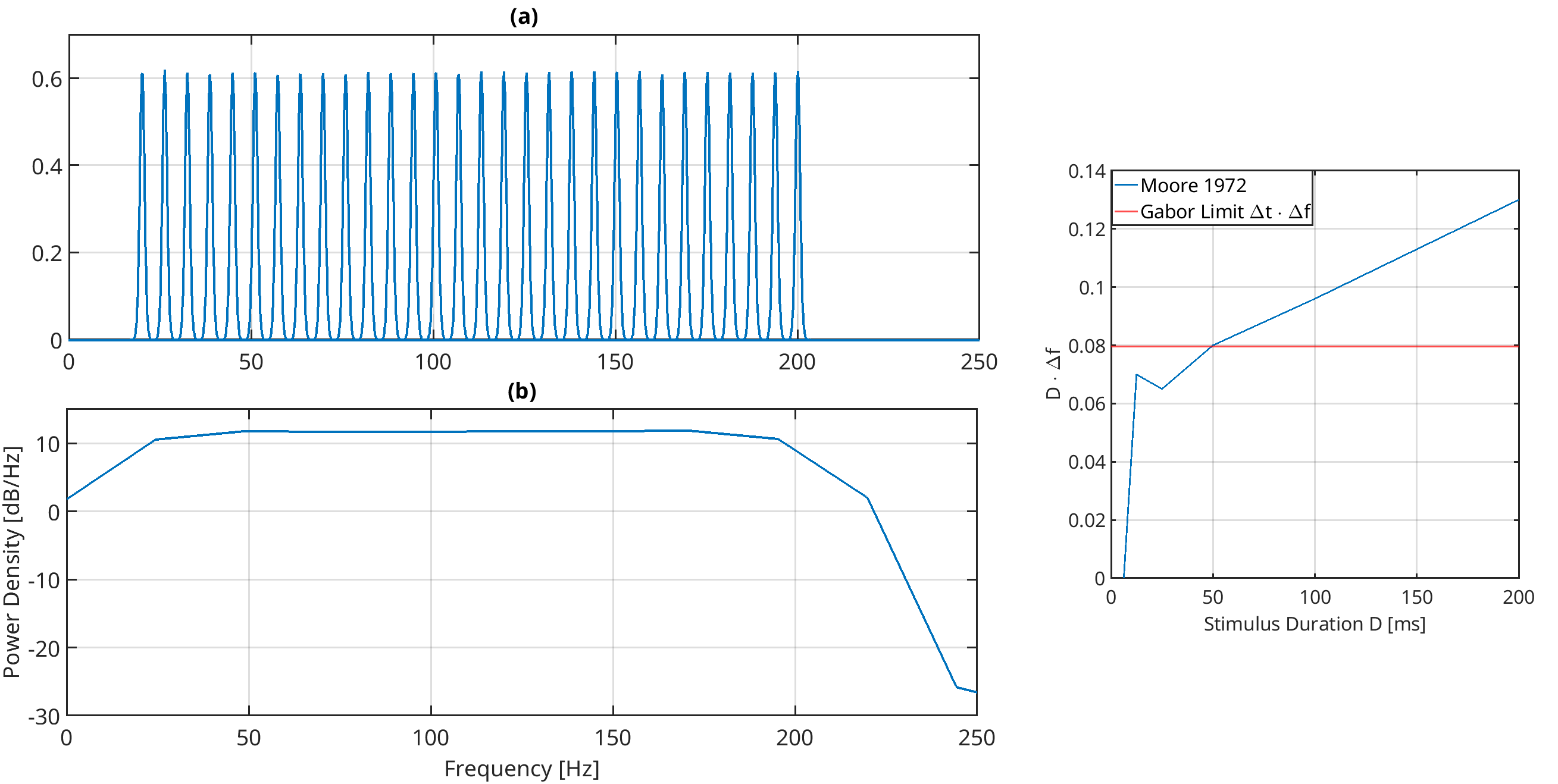
It is known that the human auditory system contains Outer Hair Cells (OHCs), which can be modeled as nonlinear oscillators. Further, it has a remarkable time-frequency resolution (Moore, 1973), with lower time-frequency resolution products below the Gabor limit (right figure). We show that this time-frequency resolution can be achieved with a Stuart-Landau Oscillator (SLO) that exhibits a subcritical Hopf bifurcation.
This raises the question of whether continuously oscillating outer hair cells can exist without producing a noticeable tone (i.e., constant tinnitus)? Our results suggest yes, if these cells oscillate chaotically. When modeled as SLOs with white system noise, every cell exhibits narrowband chaos (top left figure), with the mean equal to the cell’s characteristic frequency. By looking at the summed output of an ensemble of OHCs, the power spectrum density becomes constant, indicating a Gaussian process rather than multiple pure tones (bottom left figure). This suggests that narrowband chaos is necessary for accurate OHC models to avoid a constant tinnitus while maintaining the same remarkable time-frequency resolution.
Browse the Results of the Month archive.