
Infant Detection using UWB Radar
- Published
- Wed, Apr 01, 2026
- Tags
- rotm
- Contact
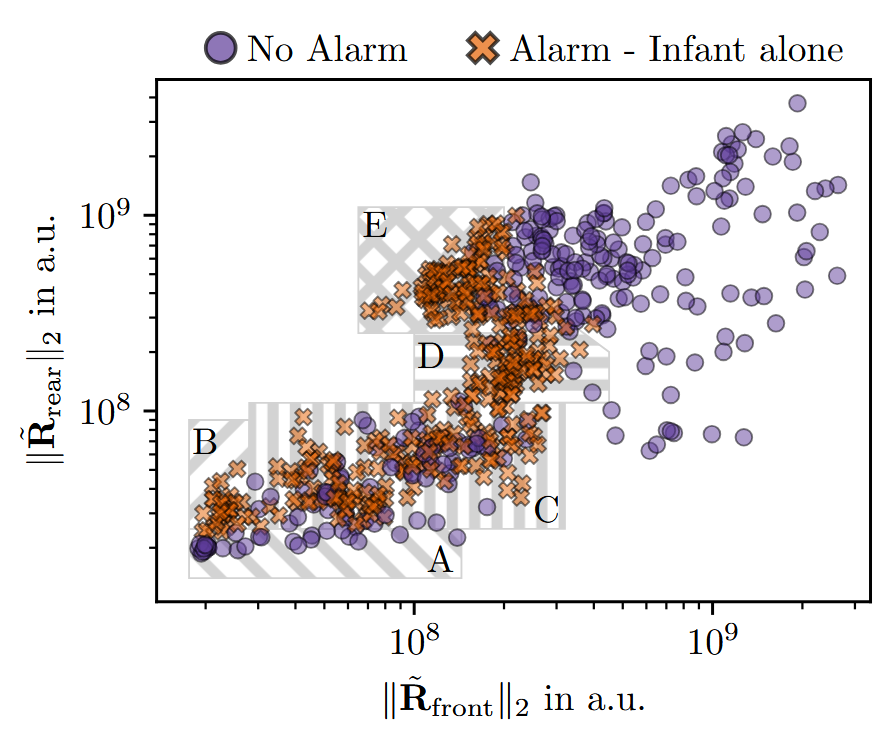
In this study, we explored the use of ultra-wideband radar to detect an unattended infant inside a car. The UWB radar device captures changes in the channel impulse response due to limb movement or chest movement caused by respiration, which can be leveraged to predict the occupancy state of the car. This problem is formulated as a binary classification task, where the goal is to determine whether to raise an alarm when an infant is alone in the car.
To address this task, we collected data from various occupancy scenarios, including different adults, an infant dummy, and combinations of both, as well as different movement patterns and people moving next to the car. Our initial analysis focused on low-level features, such as the Frobenius norm of the received radar maps from two radar devices. The results, illustrated in the figure above, show distinct clusters corresponding to different scenarios: Cluster A: empty car; Cluster B: infant alone, breathing, with no one nearby; Cluster C: empty car or non-moving child with someone outside, highlighting the influence of external movement; and Clusters D and E: infant moving. The remaining samples correspond to an adult being present in the car.
Building on these insights, we developed a set of features to perform binary classification using a two-stage XGBoost model. Our approach yields F1-scores of 97.0% when testing on a car of similar size to the training data and 93.2% when testing on a substantially larger car.
This research will be presented at the International Conference on Acoustics, Speech, and Signal Processing 2026.
Browse the Results of the Month archive.